Why Ingredients and Formulation Matter More Than Packaging
Abstract
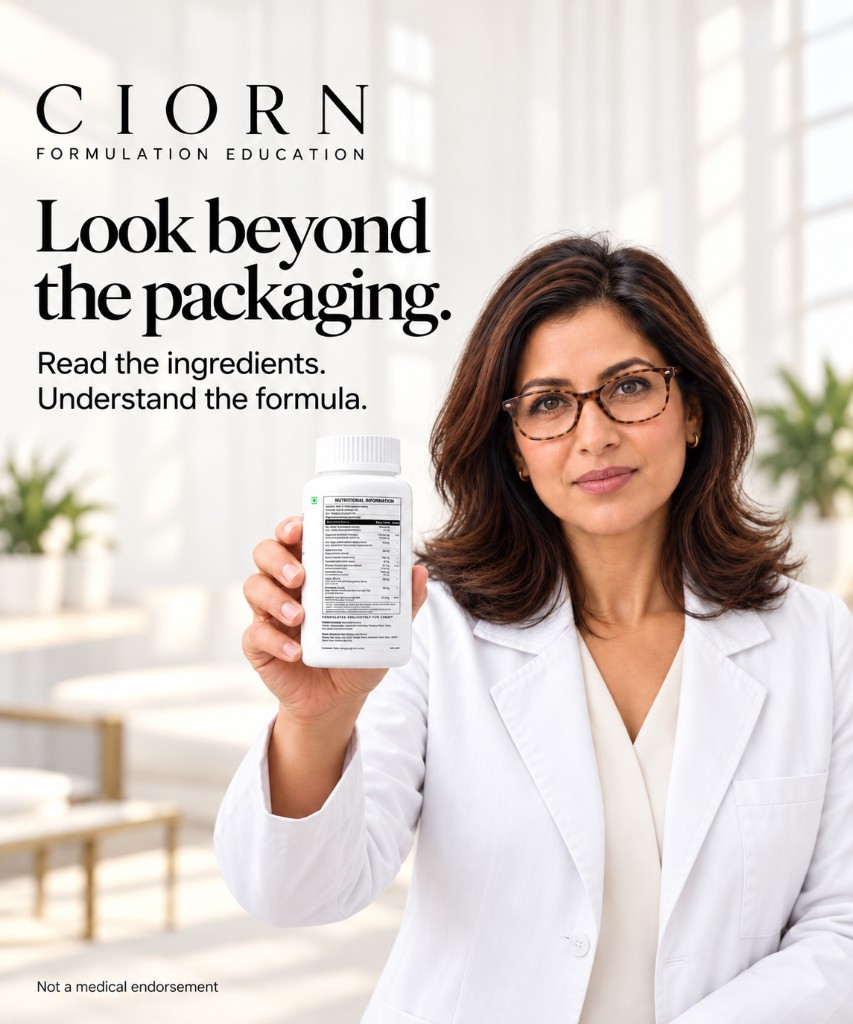
Beautiful packaging can attract attention. Understanding a beauty product means looking at its ingredients, their amounts, the evidence behind the formula, and whether it is suitable for you. This brief is CIORN’s guide to that reading — before the advertisement, and before the discount.
People meet a beauty product by its surface. The carton is designed to be desired. The advertisement is written so the result feels certain. The discount is printed large enough to hurry the decision. The ingredients, and the way they have been put together, are often the last thing looked at — when anyone looks at them at all.
Beauty products come in many forms, including oral supplements, creams, and serums. What makes one valuable is the formulation: which ingredients are there, in which form, at which amount, on what evidence, and whether that finished product is suitable for the person who will use it. CIORN publishes this brief so that reading can happen before the purchase, and so that it is applied to every brand, including ours.
Before you buy, set aside the beauty of the packaging and the pull of the advertisement. Look closely at the ingredients and the formulation. That is what makes the product valuable.
What packaging and a discount can tell you
Good packaging has a purpose. It protects what is inside, and it carries the instructions for use. Attractive design can also make a daily routine more pleasant to keep. Those are real virtues. They do not establish quality, safety, or effectiveness. An elegant bottle can make a product desirable. It cannot tell you whether the formula is well made, or whether it is right for you.
Price deserves the same separation. A premium price does not prove a superior formula. A large discount does not prove a poor one. Consider the offer after you understand the product. A saving has value when the product itself meets your needs. Until then, urgency is only a design.
| What you notice | What it can tell you | What it cannot tell you |
|---|---|---|
| Packaging | That the product is protected, and that instructions may be printed on it | That the formula is sound, safe for you, or effective |
| Advertisement | The claim the brand wants remembered | That the claim matches evidence for this finished product |
| Discount | The price on offer today | The quality of the formula |
| The ingredient list and the amounts | What is declared, in which form, at which serving | Every possible contaminant, or a result on your own skin |
An ingredient name is only the beginning
Recognising a fashionable ingredient is a starting point. In skincare and in beauty supplements, a single name is often asked to carry the whole advertisement. The useful questions come next. What is this ingredient intended to do? Which form is used? How much is provided? What evidence supports that use, at that amount?
On a supplement, check whether the declared quantity is for one capsule or for the daily serving. Two capsules a day will double a per-capsule figure, and a label that does not say which number it is printing cannot be compared with another label. When the line is an extract or a complex, ask whether the figure describes the entire mixture or a named constituent inside it.
A hypothetical extract of 500 mg, standardised to 20 percent of a named constituent, supplies 100 mg of that constituent. The two numbers describe different things. Neither number, on its own, proves a benefit. The same habit of reading applies to any headline milligram on a beauty supplement, including a glutathione figure. How to separate a complex from the active it provides is set out in Liposomal versus regular glutathione.
For a cream or a serum, look for an explanation of the ingredients and of the use the finished product is meant for. An unfamiliar name is a reason to seek a reliable account of that ingredient. It is a poor reason to assume, from the name alone, that the ingredient is harmful.
The formula needs evidence
A formulation is the complete composition of a product, including the forms and the amounts of its ingredients. A longer ingredient list does not automatically make it better. A larger headline dose does not either. What matters is whether each amount is clear, whether the form matches the purpose being claimed, and whether you are being asked to trust a finished product rather than a slogan.
Ask whether the evidence relates to an individual ingredient or to the finished product. Research on one ingredient cannot establish that every product containing it will deliver the same result. The U.S. National Center for Complementary and Integrative Health states the practical consequence: supplements bought from a shop or online may differ in important ways from the products tested in studies.[1] Dose, form, and the rest of the formula can all be among those differences.
Words such as advanced, natural, and clinically inspired should lead to further questions. What was studied? At what dose? In whom? Does the research support the particular claim being made? Natural is not a synonym for safe. NCCIH gives kava as one example of a plant supplement that can cause liver injury.[1] A manufacturer’s use of “standardised,” “verified,” or “certified” does not, by itself, guarantee quality or consistency.[1]
Safety, named specifically
A safety concern has to be specific. A general fear, and a general reassurance, are equally poor guides.
Mercury-containing skin-lightening products are a documented example of harm. Mercury salts have been used in such products because they inhibit melanin. The World Health Organization warns that mercury exposure from them can damage the kidneys and the nervous system, and that these products remain available despite bans in many countries.[2] That warning belongs to products which contain mercury. It does not mean that beauty products in general cause organ damage. A cream is not unsafe because it is a cream. It asks to be read, and mercury is one of the things a responsible reading refuses.
Oral supplements ask for a different, equally specific care. Many can be used sensibly. Excessive intake of certain nutrients can still be harmful, and supplements can interact with medicines. The NIH Office of Dietary Supplements notes that too much vitamin A can injure the liver, and that excess iron may damage the liver and other organs.[3] Natural origin does not remove that possibility.[1][3] Your health conditions, your medicines, and the amount you already take from food and from other products all change whether another product is suitable.
The label is essential, and it cannot reveal every contamination or every undeclared ingredient. NCCIH records that some products sold as dietary supplements have contained prescription drugs or other ingredients not listed on the label.[1] Independent quality testing can support the particular things that were measured: identity, the stated amounts, and harmful levels of named contaminants. The NIH Office of Dietary Supplements is explicit that such a seal does not guarantee a product is safe or effective for everyone.[3] Ask who manufactures the product, and what relevant testing is available. Then keep the answer inside what was actually tested.
If you take medicines, if you have kidney or liver disease, or if you are pregnant or breastfeeding, discuss a new supplement with a qualified clinician before using it.[1][3] Many supplements have not been studied in pregnancy or during breastfeeding.[1]
How to read a beauty product
You do not need to become a formulation scientist. A short list of questions will already put the carton back in its place, whether the product is a supplement, a cream, or a serum.
| Question | A clear answer |
|---|---|
| What is each key ingredient intended to do, and what evidence supports that purpose? | A function, not only a fashionable name |
| Are the amount, the serving size, and the directions clear? | Per capsule and per day are distinguished, and an extract is distinguished from the constituent inside it |
| Does the research match this form, this amount, and this claim? | The study is close to this finished product, not a different dose in a different formula[1] |
| Who makes the product, and what relevant testing is available? | The test is described for what it measured, and no further[1][3] |
| What warnings apply to my skin, my health, and my medicines? | Kidney or liver disease, pregnancy, breastfeeding, and current medicines are part of the decision[1][3] |
On an Indian health supplement, the label is where the serving and the amounts are declared.[4] That panel is the page worth more of your attention than the front of the carton.
The standard CIORN applies to itself
Ingredient education is part of the purchase, including a purchase from CIORN. The questions on this page are the ones we encourage you to ask of every beauty product, and of ours.
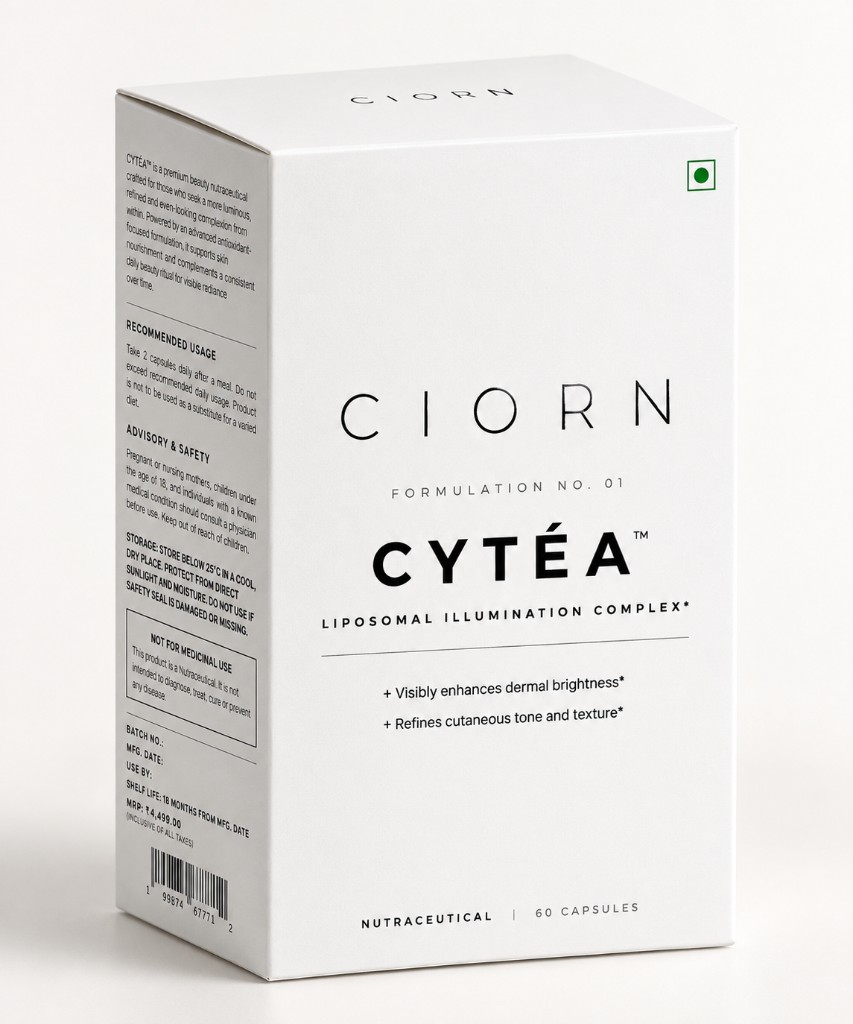
CIORN CYTÉA™, Formulation No. 01, is a daily beauty supplement made and labelled for India. One bottle holds 60 vegetarian capsules: two a day, 30 servings. Each serving is a liposomal glutathione complex of 1000 mg, providing 600 mg of reduced L-glutathione, with liposomal vitamin C and a disclosed matrix of further ingredients, each at a printed amount. The public price is ₹4,499, inclusive of taxes. The two numbers on the glutathione line are the point of the earlier example: the complex, and the constituent it provides, are not the same fact. How a daily ritual differs from a clinic infusion is set out in Beyond the IV Lounge.
CYTÉA is offered so those lines can be read. Reading them is the standard. It is not a promise of a cosmetic result. CYTÉA is a health supplement, not a medicine, and not a whitening treatment. Women who are pregnant, nursing, taking medication, or managing a condition such as hypertension, kidney disease, liver disease, or an electrolyte disorder should speak with a physician before use. Individual responses vary.
Beauty Protocol
CIORN CYTÉA™
60 vegetarian capsules. Two a day, for 30 servings. Liposomal glutathione complex 1000 mg, providing 600 mg Reduced L-Glutathione. Public price ₹4,499, inclusive of taxes.
Beautiful presentation can belong to a product you are glad to keep. Its value also depends on what it contains, how that formula is composed, and whether it is appropriate for you. For any beauty product, those are the details worth understanding before you buy.
Clarifications
Questions before choosing a pathway
How do I choose a beauty product?
Start with the formula. Read each key ingredient, the form and the amount, the serving size, the directions, and any warning. Then ask whether the evidence matches that finished product, who makes it, and whether it suits your skin, your health, and your medicines. Packaging, an advertisement, and a discount can be considered after that reading. They cannot replace it.
Does attractive packaging mean a beauty product is well formulated?
No. Packaging can protect what is inside and carry the instructions for use. An elegant bottle can also make a daily routine more pleasant. Appearance cannot show that a formula is well composed, that a claim is supported, or that the product is suitable for you.
Does a large discount mean a formula is poor?
No. A discount does not prove poor quality, and a high price does not prove a better formula. Understand the product first. A saving has value when the formula already meets your needs.
What is the difference between an ingredient and a formulation?
An ingredient is one substance in the product. A formulation is the whole composition: which ingredients are used, in which form, at which amount, and how they are put together. A fashionable ingredient name, a longer list, or a larger headline dose does not by itself make a formulation better.
Can skin lightening products damage the kidneys?
Some can, and the risk has to be named specifically. The World Health Organization warns that mercury-containing skin-lightening products can damage the kidneys and the nervous system, and that such products are still found even where they are banned. That warning is about products that contain mercury. It does not mean beauty products in general harm the kidneys. Oral supplements need a separate kind of care: excess of certain nutrients can be harmful, supplements can interact with medicines, and anyone with kidney or liver disease should speak with a clinician before starting one.
Does research on one ingredient prove a beauty product works?
No. A study belongs to the form, the dose, and the product that were studied. The U.S. National Center for Complementary and Integrative Health notes that supplements sold in shops or online may differ in important ways from the products tested in research. Ask whether the evidence matches this formula and the particular claim being made.
Who should speak to a doctor before a beauty supplement?
Anyone who takes medicine, has kidney or liver disease, or is pregnant or breastfeeding should discuss a new supplement with a qualified clinician first. CIORN CYTÉA is a health supplement, not a medicine. The same conversation applies before CYTÉA, including for anyone managing hypertension or an electrolyte disorder.
Beauty Protocol
CIORN CYTÉA™
60 vegetarian capsules. Two a day, for 30 servings. Liposomal glutathione complex 1000 mg, providing 600 mg Reduced L-Glutathione. Public price ₹4,499, inclusive of taxes.